Consignment Note Example: What Every Consignment Document Must Include
Consignment runs on trust — and trust lasts longest when there is paper that records it. Without a note, every stock or billing difference turns into a contest of memory between you and the store owner.
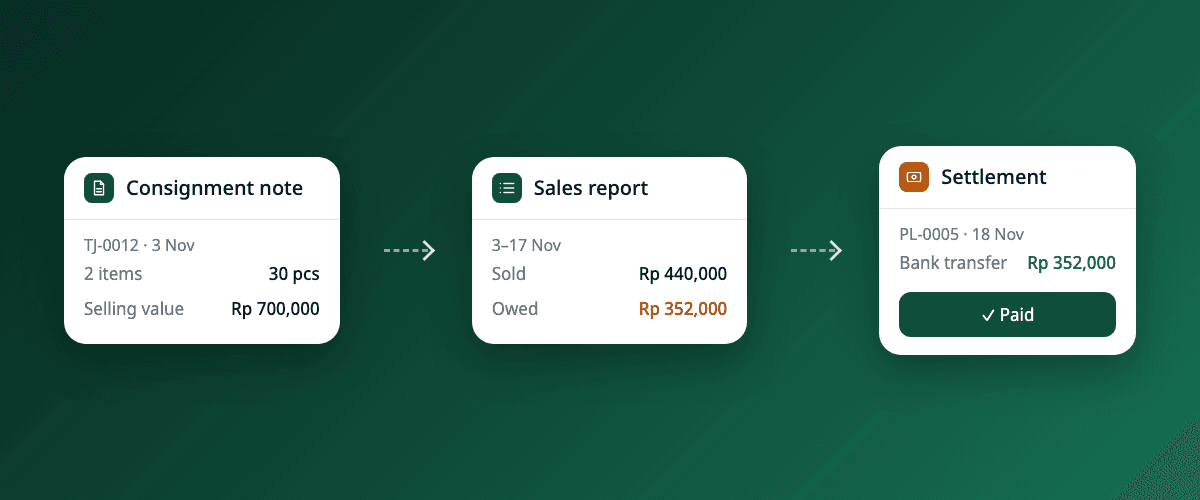
One consignment cycle should always produce three documents. Here's what goes on each, with examples.
1. The consignment note (when goods are delivered)
The consignment note proves the goods were handed to the store. Make it in duplicate — one copy for the store, one for you — and make sure the store signs it.
What it must include:
- a note number and date,
- your name and contact as the owner of the goods,
- the receiving store,
- the goods: name, quantity and selling price,
- the store's commission (a percentage or rupiah per item),
- terms: the billing period and what happens to unsold goods,
- signatures from the sender and the receiver.
Example — Note No. TJ-0012, 3 November, Toko Sumber Rezeki:
| Item | Qty | Selling price | Value |
|---|---|---|---|
| Spicy Chips 100 g | 20 | Rp10,000 | Rp200,000 |
| Layered Cake | 10 | Rp50,000 | Rp500,000 |
| Total selling value | Rp700,000 |
Store commission: 20% of the selling price. If everything sells, you receive Rp700,000 − Rp140,000 = Rp560,000. Billing every two weeks; goods close to expiry are withdrawn by the owner.
2. The sales report (when the store reports what sold)
At the end of the period, you and the store agree how much sold. This report is what the bill is based on.
What it must include: the reporting period, the consignment note it refers to, quantity sold per item, total sales, commission, and the amount the store owes.
Example — sales report, 3–17 November, Toko Sumber Rezeki:
| Item | Sold | Selling price | Sales | Left at store |
|---|---|---|---|---|
| Spicy Chips 100 g | 14 | Rp10,000 | Rp140,000 | 6 |
| Layered Cake | 6 | Rp50,000 | Rp300,000 | 4 |
| Total sales | Rp440,000 | |||
| Store commission 20% | − Rp88,000 | |||
| Owed by the store | Rp352,000 |
The "left at store" column is often skipped, yet it's what you check against the shelf when you visit: 20 − 14 = 6 packs of chips and 10 − 6 = 4 cakes.
3. The settlement receipt (when the store pays)
The settlement receipt proves the bill was paid.
What it must include: a receipt number and date, the sales report being settled, the amount paid, how it was paid (cash, bank transfer and so on), and the receiver's signature or name.
Example: Settlement No. PL-0005, 18 November — Toko Sumber Rezeki paid Rp352,000 by bank transfer for the 3–17 November sales report.
Mistakes that make bills not add up
- A consignment note the store never signed. When stock doesn't match, you have no proof of how much was delivered.
- A sales report with no remaining stock. The bill is right, but you don't know what is still on the shelf.
- Commission not written on the note. The "20% of the price" versus "20% on top of the price" misunderstanding only surfaces at billing.
- Payments not tied to a report. A few months on, it's hard to tell which reports are paid and which aren't.
Making all three without retyping
You can make these in Word or Excel, but the numbers have to be retyped every time — and every retype is a chance for a mistake.
In Melacak, all three come from the same data. A delivery to a store prints as a note. A sales report works out the total, the commission and the amount owed, and can be printed or sent to the store as a link it opens without logging in — including through a WhatsApp reminder. A settlement records the amount and how it was paid.
Try Melacak free and print your consignment documents without retyping a single number.