How to Calculate Consignment Commission: Formulas, Examples and a Costly Misunderstanding
In consignment the store doesn't buy your goods — it earns a share of every item that sells. That share is the commission, and there are several ways to calculate it. The trouble is that both sides often feel they agreed on "20%" when they each meant something different.
This article covers the three most common ways to calculate a consignment commission, the formulas, worked examples, and the misunderstanding that most often makes a bill not add up.
1. A percentage of the selling price
This is the most common. The store keeps a set percentage of the selling price of each item sold.
Commission = selling price × rate × quantity sold
What you receive = total sales − commission
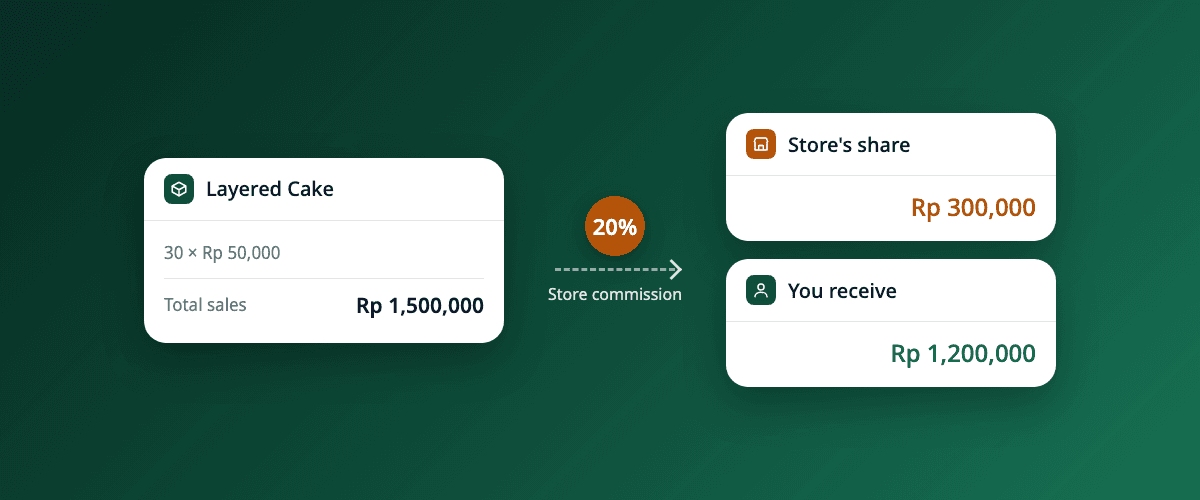
Example: you consign layered cake at a selling price of Rp50,000, with a 20% store commission. This month 30 cakes sold.
- Total sales: 30 × Rp50,000 = Rp1,500,000
- Store commission: 20% × Rp1,500,000 = Rp300,000
- You receive: Rp1,500,000 − Rp300,000 = Rp1,200,000
The advantage is that one percentage covers every product at that store, so it is easy to calculate.
2. A consignment price (the store sets the margin)
Here you set a consignment price — what you receive per item — and the store is free to set its own selling price. The store's profit is the difference.
What you receive = consignment price × quantity sold
Example: consignment price Rp40,000, the store sells at Rp50,000, 30 sold.
- You receive: 30 × Rp40,000 = Rp1,200,000
- Store's profit: 30 × (Rp50,000 − Rp40,000) = Rp300,000
The result matches the first example, but the logic differs: you don't need to know the final shelf price — which also means you can't control it.
3. A fixed commission per item
The store earns the same rupiah amount on every item sold, whatever the price.
Example: chips sold at Rp10,000 a pack, a Rp2,000 commission per pack, 50 packs sold.
- Total sales: 50 × Rp10,000 = Rp500,000
- Store commission: 50 × Rp2,000 = Rp100,000
- You receive: Rp400,000
This suits low-priced products with a uniform price.
The "20%" misunderstanding
You say, "The price is Rp50,000, commission 20%." There are two ways to read that:
| How you meant it | How the store read it | |
|---|---|---|
| Shelf price | Rp50,000 | Rp60,000 |
| Store's share per item | Rp10,000 | Rp10,000 |
| What you receive per item | Rp40,000 | Rp50,000 |
Over 30 items, the difference in what you receive between the two readings is Rp300,000 — yet both sides think they "agreed on 20%".
A similar mix-up happens between commission and markup. Commission is calculated on the selling price, markup on the consignment price:
- A 25% markup on a Rp40,000 consignment price → a Rp50,000 selling price → the same as a 20% commission.
- A 20% markup on Rp40,000 → a Rp48,000 selling price → the store gets only Rp8,000, about 16.7% of the selling price.
So write the agreement out in full on the consignment note: the shelf price, who absorbs discounts, and what you receive per item — not just a percentage.
Other things to agree on
- Discounts. If the store discounts, is the commission on the normal price or the discounted one?
- Damaged or lost goods at the store. Who covers them?
- Different commissions per store. Stores in busy locations often ask for more. That's fine — as long as it's on record, because each store's bill will differ.
- Tax. If your business or the partner store is a VAT-registered entrepreneur (PKP), consignment transactions have their own rules — check with your tax adviser.
Calculating commission without a calculator
Working out one bill is easy. Working out ten stores' bills, each with its own commission, every month, is what's exhausting — and error-prone.
In Melacak, a commission rate is stored for each store. Every sales report works out the total sales, the store's commission and the amount the store owes you. The commission is also saved on the report itself, so if a store's commission changes, older reports keep the rate that applied at the time.
Try Melacak free and let every bill use the right commission.