What Is Consignment? Meaning, How the System Works, and Examples
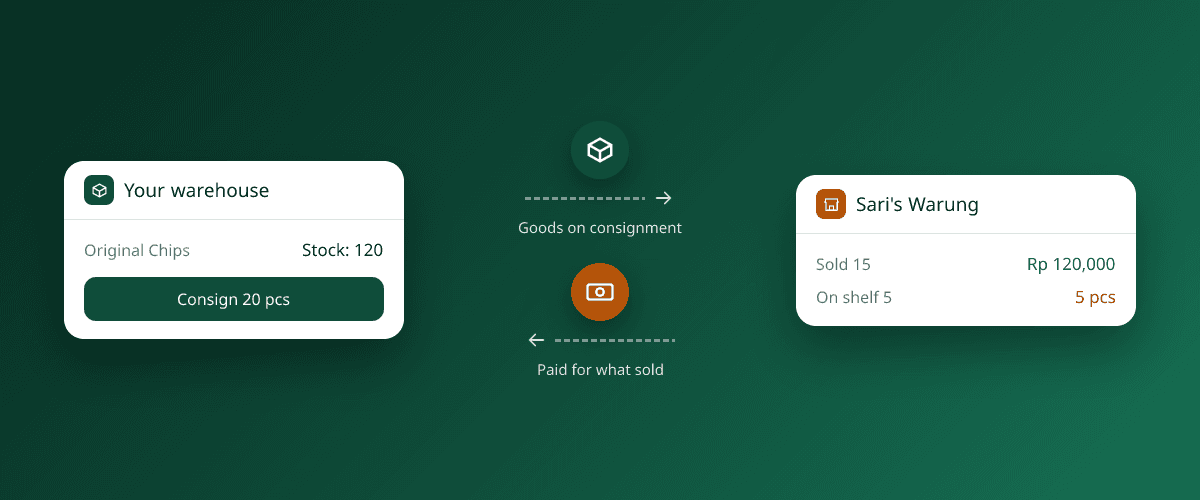
Consignment is selling on deposit: you, the owner of the goods (the consignor), place products with a store or reseller (the consignee), and the store pays only for what actually sells. Until then the goods remain yours — and can be taken back.
The model is everywhere in Indonesia: cakes in neighborhood warungs, small-brand products in souvenir shops, local fashion in distros. This article covers what consignment means, how the system works, a concrete example, the trade-offs, and how to manage it without losing track.
What consignment means
A consignment arrangement involves two parties:
- Consignor (the owner) — produces or owns the goods, places them with sellers, and keeps ownership until items sell.
- Consignee (the store) — displays and sells the goods, earning a commission or margin on each sale.
The key contrast is with outright sale: there, the store buys your goods upfront and carries the risk of unsold stock. In consignment that risk stays with you — in exchange, stores say yes to your product far more easily.
How the consignment system works
The typical flow:
- Agreement. You and the store agree on selling price, commission or revenue split, and a settlement schedule — ideally in a written consignment agreement.
- Shipment. You send goods to the store, recorded as consigned stock — your inventory at their location, not yet a sale.
- Sales. The store sells to customers. Every item sold becomes a receivable from that store.
- Settlement. Periodically — weekly or monthly — you collect payment for what sold, usually against a sales report.
- Returns. Unsold or expired goods come back, and your warehouse stock records go back up.
A concrete example
Picture a chips producer with 10 partner warungs. Every Monday they deliver 20 packs to each warung at a Rp10,000 selling price with a Rp2,000 commission per pack. The next week they make the rounds: warung A sold 15 packs (they collect 15 × Rp8,000 = Rp120,000), warung B sold 8, and so on — while noting remaining stock and topping up deliveries.
With one warung this fits in your head. With 10 warungs and 30 products it becomes hundreds of numbers that change weekly — which is exactly where most consignment sellers lose the thread.
Advantages and disadvantages
The upside:
- Products reach many stores without the store spending capital — much easier market entry.
- Wider distribution without opening your own outlets.
- Partner stores win too: sellable products with no dead-stock risk.
The downside:
- Cash arrives only after goods sell — slower cash flow.
- Damage, loss, and unsold stock remain your risk.
- Most common of all: losing track. Stock spread across stores, per-store prices, and stacking receivables overwhelm a spreadsheet fast.
Managing consignment without the chaos
Healthy consignment is a bookkeeping discipline: how much stock sits at each store, what sold, and who owes what. That's precisely the part that falls apart when done by hand.
Melacak was built for exactly this: every shipment is recorded, per-store stock stays accurate, sales roll up into settlements automatically, and when it's time to collect you send the report — with WhatsApp reminders and a report link the store can open without logging in.
Try Melacak free — and let the system memorize the numbers, not you.